Agile 101: Scrum in a maintenance project

There is a common doubt among those considering using Agile methodologies to manage a project: would it be possible to apply Scrum to projects where, on top of the upcoming and planned tasks, there are frequent interruptions to solve maintenance problems, to correct errors or to resolve issues? Many project managers face these types of problems and use several approaches to tackle them. Let’s see some of those approaches: 

Short sprints

With this solution, we will keep the tasks that have already been programmed for that sprint. If our sprints are 1 or 2 weeks long, we will be able to make the unplanned tasks a priority on the to-do list for the next sprint. If the sprint is one week long, we will start urgent tasks after 3 days, on average.
In an ideal world, this would work but it would pose some disadvantages. Not every issue can wait for a few days to be solved. A whole service could depend on it.


Low load factor

If we know that as a general rule we will have unplanned tasks or issues that we must solve quickly, we can lower our load factor during the sprint so we have “room” to solve these problems.
If in each sprint the team has the capacity to solve 10 planned stories, we could promise to deliver just 7, so the team has time to solve urgent issues. That way we won’t fail when it’s time to deliver what we promised, sprint after sprint.

In my opinion this solution can be useful in some projects but it could create another problem. Let me explain. Normally the load factor is 75%. If we lower it so we’re able to devote 30% of the team’s time to urgent tasks, we should apply a load factor ranging from 40 to 50%. On this 40% we’re using Scrum but, how are we managing the rest of the team’s time? What do we know about that pile of tasks that we’re solving sprint after sprint?


A different team for each type of task

This solution consists of having a Scrum team for the identified and planned tasks, and a Kanban team for the urgent issues. With Kanban we can add new tasks to the TO-DO column as they arrive, and we will follow them up until they get shifted to the DONE column. With this the team will be even more agile, reducing the overhead in meetings and planning that we could suffer with Scrum.
We still have a dilemma with unplanned tasks, which are, well, unplanned. There will be times when the Kanban team providing support will be oversized, because there are very few issues. But then a week later the number of issues and their importance could be so high that we will need any help we can get.

To minimise those risks, we could rely on the previous solutions. We could have short sprints, so the Scrum development team can plan the tasks for the next iteration. We could also use a lower load factor so the team can have a bit of room in their planning to give a hand if needed. In the same way, the support team can help with planned sprint tasks when their TO-DO column starts to look empty. To make the most of this, it would be good if all members in all teams rotated, so that everyone knows every aspect of the job.

You can find texts like this and many other about how to manage agile projects in my book Agile 101: Practical Project Management (available on Amazon).

Translation by Begoña Martínez. You can also find her on her LinkedIn profile. Proofreading by David Nesbitt.
Publicado en Blog, Blog 1, English | Etiquetado , , | Deja un comentario

Agile 101: How to write an Agile book

Yes, you can also write a book in an Agile manner. Not only software can be created this way. All these Agile things can be applied to a myriad of fields, not only to technology. In this chapter I will tell you how I used this work philosophy to write the book that you have before you:

Focus on what’s important,
delete the non-essentials

Nowadays books—especially technical books—are going through the same phenomenon as CDs did a few years ago. You bought a CD only because you had heard that song on the radio, but, how could a CD have less than 20 songs (and cost less than 20 dollars)?

It had to be filled up with something. Maybe the last few songs did not have the same quality as the two or three first hits in the disc? Well, it was necessary to justify the price, to pad it a little. This could make you hate the author for those last three songs in a duet with Tom Jones or the techno-pop version of their first hit.

The same can happen with books. We feel better if our book is 500 pages long, and we write it for two years but, at what cost to you, the writer? And for the reader who buys it? Probably that reader is only interested in the chapters on Agile quotes or about Scrum’s advantages.

Something of the sort happened to me while I wrote this book. It had very few pages and I was tempted to add some filler chapters. They weren’t really as interesting as the rest and they weren’t as close to the main subject of the book. I ended up taking them out. The first version of the book was about 67 pages long, but I chose to keep it that way instead of having readers think that the book was too long or too boring.

Real artists ship!

This expression, attributed to Steve Jobs refers to the fact that real artists are not constantly re-thinking their work until they have the perfect painting or the perfect sculpture. They ship their works, put them up for sale, and then see what the market is really interested in.

Have you written a tutorial on how to install Pentaho? A WordPress configuration manual? What are they doing in a drawer? Get a cover (there are hundreds of websites for that), format it, write an attractive description, and put it up for sale at Amazon’s KDP, at iTunes or wherever you want.

It is only 30 pages long? Well, then sell it for one or two dollars. If you sell a few you’ll get a return for the 20 or so hours that it took you. Also, you’ll have learned lots of things about digital marketing, sales, royalties…and also about which kinds of subjects sell books and which don’t.

Perfection is a vertical
asymptote

No matter how much you try to write the perfect book, with the perfect cover, with the exact price to maximise sales and no typos… you won’t be able to do it. Perfection is a vertical asymptote (sorry again, Math 101 Calculus).

The better you try to make it, the higher the cost will be for you. When you’ve put an enormous amount of hours into it, putting in another enormous amount won’t get you any closer to getting a bestseller.

When I put the book up for sale, I realized from the first opinions on the book that users thought it would be a Scrum manual. I had to learn from that and change the description to make it clearer. Small changes in the description had very high impact on sales.

In the same way, when I updated the book to its second cover, sales increased by 30%. Sadly it went further down when I changed it to the third cover. It was more expensive, and in my opinion prettier, but apparently Amazon’s users didn’t like it.

Your leads will tell you if they find the content, the cover or the subject interesting or not. You can think it over again and again, but until the book is not in the virtual shelves you won’t know what works and what doesn’t. Avoid the paralysis that sets in with perfectionism and don’t overthink it. Put your book up for sale and let them decide (remember, real artists ship!).


You can find texts like this and many other about how to manage agile projects in my book Agile 101: Practical Project Management (available on Amazon).

Translation by Begoña Martínez. You can also find her on her LinkedIn profile. Proofreading by David Nesbitt.

Publicado en Blog, Blog 1, English | Etiquetado , , | Deja un comentario

Agile 101 book: Scrum’s advantages

Scrum pros and cons: blue pill, red pill

I don’t want to become one of those Agile evangelists, preaching everywhere about how good and modern it is to be agile. But now that we’ve discussed the disadvantages of Scrum, we should look at Scrum’s advantages. I’m going to focus on one of its brightest features: regular deliveries. Thanks to these deliveries, Scrum will make the following possible:

Clients can start using their products

The client can start using the product even if not all the elements have been built. If 20% of the new features have been developed—which are the features that will be used 80% of the time according to the Pareto principle—users could start enjoying the product.

With the feedback of users after trying out one of the deliveries, we might realize that some of those features are far more important than 80% of the remaining tasks in the Product Backlog. Somebody could say “but the draught of the new regulation no longer requires a signed approval form” or “actually what we need is a button that would cancel the procedure” (we actually received these two comments in real life).

We can decide where we’re going

Businesses change, needs change, regulations change. And what was key when the project was signed might not be so important six months later. The client can pursue new goals, what to do in each new sprint and what we should focus on in our next delivery.

Divide and conquer

Colossal tasks require colossal efforts. If we must deliver just a part of that task every two weeks, our load will be lighter. Smaller, more manageable tasks make us feel that our job is easier. In each delivery, we have the feeling of having advanced one more step towards the final goal.

Fewer surprises

When we see our product grow, little by little, we all get an idea of what we are doing with it and if it is going to be useful or not. Also, we will know pretty accurately at what speed things are being delivered and how long it will take to finish up. Should we correct our course? We would know that in weeks.

Deliver what the client needs

One of the basic principles of Scrum (and also one of its main challenges) is accepting that clients can change their minds about what is or isn’t necessary. With Scrum, we strive towards providing a flexible response, admitting that clients themselves may not have put their finger exactly on the problem, and that often, as the project advances, they may come to realize what they truly need. That is why, among other things, Scrum is considered an Agile methodology.

The list of requirements and features created at the beginning is open and can be modified at any time. It contains rough estimations of the amount of effort that each feature requires. Before each iteration, or sprint, a group of these requirements is set as the goal for that period. Two or three weeks later, requirements may have shifted and the new goal might be in another direction, rather than the one that was set a few sprints back.

It is a new way of working, and a bit hard to adopt, for both the client and the provider. There are other, apparently easier, ways. We can always go back to the traditional formula. First we analyse the problem for months. When we’ve determined what should be built, we start developing it for a few months more. When we’re finished, we cross our fingers and deliver our final product to the client.

After this step, who hasn’t heard sentences like: “but this is not what I wanted, there’s this thing missing here…” or “no, it wasn’t like this, you misunderstood me” or “yeah, it’s fine, but I’m going to call the Director, actually he’s the one who has to sign it off” After months of work, of stress and rushing around to deliver by the deadlines, clients have not received what they need and we need to work even more to try and patch up the proposed solution.

How Scrum helps to build big projects

Revisiting Raúl Hernández post “Learning how to build cathedrals” I started reflecting on that well-known story about building cathedrals. In the story, two workers are chipping stone to build a cathedral and somebody asks them what are they doing. One complains about how hard and never-ending it feels to build the wall he is working on while the other one simply replies “I’m building a cathedral.”

I have wondered if it is possible to be agile when you are building something so big. I think that the answer is yes, you can. At least I can think of a few advantages of being agile when you are immersed in a project that is the size of a cathedral:

With a framework such a Scrum, you’ll always bear in mind the final goal and the features it should have. In the Sprint Backlog you will have a series of requirements such as the creating a ground plan, raising the vault, decorating doors and windows, and many other things that will give shape to the final cathedral.

But once the goal has been defined, we have to start chipping stone. At the beginning of each iteration, the team will choose which tasks can be started from the list of things that are pending construction (and that has been prioritized by our client). We will define a smaller goal for the next few weeks, so we’ll have a new goal, a much closer goal that will help us not to despair at the distance that still separates us from the final goal. It is the moment to pick up our hammer and our chisel.

When our pending tasks are divided into small groups to be solved in fixed amounts of time, they are timeboxed. This is a divide and conquer strategy. Plan your most immediate goal and what you will do to solve it without getting overwhelmed with all the work still pending. A Burndown Chart will also help you see how the amount of pending work is diminishing and that, however slow it may seem, you are making progress towards your final goal: the cathedral.

You can find texts like this and many other about how to manage agile projects in my book Agile 101: Practical Project Management (available on Amazon).

Translation by Begoña Martínez. You can also find her on her LinkedIn profile. Proofreading by David Nesbitt.

Publicado en Blog, Blog 1, English | Etiquetado , , | Deja un comentario

Agile 101: Scrum pros & cons


“There is nothing more difficult and dangerous, or more doubtful of success, than an attempt to introduce a new order of things.”


Machiavelli


Disadvantages of using Scrum

How many technologies have quickly popped up and then vanished even quicker? They all promised to be revolutionary, the new silver bullet that will end every problem in the software industry. When we get as much hype as has been lavished on Scrum and Agile, our first reaction is to raise a critical brow.
If you are adopting Scrum in your project or company, it is best for you to be informed beforehand about its drawbacks:

The team might be tempted to follow the shortest route

When we have things to deliver every two weeks, and in the latest deliveries the projected functionality wasn’t ready and the speed of the team does not indicate that we will finish the next one on time, we have a problem. We can succumb to the temptation of finishing the pending tasks in any way we can and leave a “technical debt” behind us. Everything has the appearance of going well, we create more features, we start new things, and the client is happy because deadlines are being met.

But every time you leave a small hole of a deficit behind you, I can guarantee that you will stumble on it again and make it bigger. If new things keep caving in this way, the “debt” will become a pit. Sooner or later you’ll have to stop everything and fill in the pit—pay back that loan and with extra interest because of that late payment. The project doesn’t finish when we were so close to the end, and the burndown chart appears to have a horizontal asymptote at 0 (sorry, Calculus I).

Do you need to have delivery deadlines way in advance?

This is one of the main criticisms that Scrum normally receives. In a way, it is logical that Scrum cannot give you those deadlines. At the beginning of the project, you cannot predict when you’re going to finish, if you’re making it easy to change the thing being built as time goes by. But, do you prefer a product that you know “for certain” will be finished in 12 months, but is built over the ideas and opinions you had a year earlier? Maybe you prefer a product that could be finished in a similar period of time, but that you have been able to steer towards your real needs, and you’ve been able to use and test before the final delivery deadline.

Stress!

We cannot sprint for our whole lives. We deliver something and the next deadline is just two weeks away. Then another one, and another one. If we have to run like this for many miles, we will sprint really hard for the first deadline, but we will walk for the last one —and that, with luck. It is something we should bear in mind during planning, from the start.

Is your team able to self-organize?

One of Scrum’s principles is that the team members must make their own decisions and self-organize. Also, one of the requirements is to avoid having teams that focus just on specific tasks, like analysis, testing, design, documentation, development etc., but rather to make sure that every member of the same team can carry out all of these tasks without depending on external teams or members. Can we always have a team like this? What happens if we don’t have one, or if we lack a key component?

You can find texts like this and many other about how to manage agile projects in my book Agile 101: Practical Project Management (available on Amazon).

Translation by Begoña Martínez. You can also find her on her LinkedIn profile. Proofreading by David Nesbitt.
Publicado en Blog, Blog 1, English | Etiquetado , , , | Deja un comentario

Agile 101 book: Requirements might change

A few years ago, before completely applying this whole Agile thing, I worked in the development of a web application that should manage the client’s worksheets through a series of steps, a wizard that would lead users through the phase they were in.

We made a full analysis, we collected all the client needs, and from there we compiled a list of features to be implemented. All very normal. Correct, coherent features that solved specific problems. With a thick requirements document and their respective designs, we started to implement these features, one after another.

Back then, we tried to be a bit Agile (in a way) and every two weeks in pre-production we showed how things were going. It didn’t look half bad. It was easy to use and we even got congratulated by clients on the work they were seeing.

We were happy like that, so we went on until we developed, with no small effort on our part, all the features that were included in the analysis document that had been approved. And we deployed them into production…

And as soon as the administration staff used the application for a few days, they realized they could have done with some changes: include a table in each screen with the original documents, so they wouldn’t lose sight of them; avoid going out to another menu when creating an entity; adding more controls at the end to avoid mistakes when filling them in, etc… Most of them were minor changes that wouldn’t take more than two or three days of development, but we had already exhausted our budget (and more).

Amongst the features we had developed from the beginning, there were some complex ones that allowed complicated changes between projects and that were difficult to develop (and test, in order to be able to check every possible case). I asked about them months later but nobody knew anything about them or which menu they were in. It wasn’t considered important. When they had needed something like that, they had cancelled the process and started a new one.

When we started the project, neither I, nor the client, nor the users had an exact idea of what would work well. We simply couldn’t know for sure. What could have been done to avoid this? Well, we should have deployed the basic features to production as soon as they were ready. That way we would have easily seen all these little changes that would have made the application much more practical and easy to use.

From that moment on, in new projects, when users see the need for changes like these, they ask me about the possibility of including them. They have no problem giving up other features for which they no longer remembered the reason for including in the initial contract or that no longer made much sense.

The feature list is drafted from the beginning in the Product Backlog. The client is aware of this estimation and simply says: “Take out feature 18, which would take 8 days’ work, and change it for these other two features which would take 6 days. We save those two days in case we need some other change.”

That is another Agile principle:

Welcome changing requirements, even late in development. Agile processes harness change for the customer’s competitive advantage.

In general, it is advantageous for clients because they get a product that works and is not broken until a new contract for corrective maintenance is drafted (which would involve paying extra money). But it is also an advantage for us as providers, because we offer a project that is a good reference, in which we are aware of and can account for every hour we spend, and we avoid delivering a product that depletes our budget but still lacks important features.

You can find texts like this and many other about how to manage agile projects in my book Agile 101: Practical Project Management (available on Amazon).

Translation by Begoña Martínez. You can also find her on her LinkedIn profile. Proofreading by David Nesbitt.

Publicado en Blog, Blog 1, English | Etiquetado , , | Deja un comentario

New chapter from book Agile 101: Principles Behind the Agile Manifesto

Nearly 15 years ago, in 2001, 17 software developers met in Utah. They were critical of the then popular software-development models, which they considered rigid or heavy. That meeting included people like Kent Beck, Martin Fowler or the Scrum founders. They had decided to meet in order to talk about the new techniques and processes to develop software.
That meeting gave rise to a number of principles governing the new alternative (and Agile) methods they were proposing: the Principles behind the Agile Manifesto. One of these principles is:

Our highest priority is to satisfy the customer
through early and continuous delivery
of valuable software.

Clearly, this is what should be done in any type of development. We start every project with that in mind, but soon people start getting into a rush. Our director asks how many hours we’ve spent (and we’ve spent a lot already). Our client asks when all the features will be ready. Our workmates ask if they can take that two-week holiday we owe them.

It starts to look ugly. We’re in a mess again. We have to redo the Gantt chart with the new delivery deadlines, we have to look for another set of dates for those holidays (even our own holidays), and we have to give the director loads of explanations. “The client requested lots of changes” “The technology was new.” “We miscalculated.”

Here’s where we should be firm and ask the team for some extra effort, and decline little changes requested by the client. If it isn’t written exactly like that in the contract we signed or the minutes of a meeting we had six months ago, we’re sorry but we can’t do it.

The thing is, clients also did this. They wrote a very clear contract in which they stated each and every feature that they wanted (or the ones they wanted when they drafted it). Maybe they no longer needed those features or had realised that there were other, more important things, but they’re in the contract and they should be done. The project cannot end and leave 30% of undeveloped functionality.

At the moment, we have lost sight of what should be our top priority in our job: early and continuous delivery of valuable software. From here on, there are just tough negotiations and a contract that we would try to fulfil as soon as possible with the least amount of damage possible.

The contract might have tonnes of clauses and stipulations, but regardless of what it says, what the client wanted on signing it was a solution to the problem at hand, not an argument about whether to implement one functionality or another.

But if we deliver our software early and often, we can let clients test it and use it and tell us what they think. We can allow them tell us if there is something missing or what could be improved. They will want us to implement things they find they now need, and they will be delighted in turn to take out that .rpt file-exporting feature that no one remembers requesting or knows why it was requested in the first place.

When we finish the project, the client will have a product that really solves their problems, one that has been evolving while they learned, and one that they have been able to use and test from the early stages of the project. It sounds better for both the provider and the client, right?

New chapter from Antonio Martel's book, Agile 101: Principles Behind the Agile Manifesto
 “How do you
manage a project when you have received no previous training in project
management? Well, by suffering a lot.”
Albert Cubeles

You can find texts like this and many other about how to manage agile projects in my book Agile 101: Practical Project Management (available on Amazon).

Translation by Begoña Martínez. You can also find her on her LinkedIn profile. Proofreading by David Nesbitt.

Publicado en Blog, Blog 1, English | Etiquetado , , , | Deja un comentario

Agile 101 book

Pretty soon my first book on Agility will be also available in a new English edition. You will be able to find there same contents and same topics that were addressed at the Spanish edition or that you can find here in my blog but ready for English speakers:

  • Scrum pros and cons
  • Agile estimations with Scrum
  • Help and hints to pass your Professional Scrum Master (PSM I) Certification test.
  • Real life projects experience and practical know-how on how to deal with situations that we all have gone through any time in our professional lifes.
I leave you here with the foreword of this brand new edition (translation by Begoña Martínez. You can also find her on her LinkedIn profile. Proofreading by David Nesbitt):

“Extra! Extra! New edition Agile 101. Read all about it”


Your company has just appointed you project manager. You’ve heard about Agile methodologies, Scrum, Kanban, and lots of other things you’d like to try. You’ve started reading all about artifacts, principles, and manifestos, but nothing is crystal clear just yet.

You don’t know whether your lack of knowledge will put your project at risk, but probably what worries you the most is that all these things are nothing but buzzwords, the current fad, and that they won’t have any real effect on your day-to-day work… or even worse, that such a big change in what to call things and how to do them will make your team, your clients, and your company reject those ideas altogether. Luckily for me, or unluckily maybe, I have also gone through all these problems, so in this book I will tell you how I solved them (when I’ve been able to) or, at least, what I tried and what eventually failed.

Don’t expect this document to be an exhaustive Scrum guide. I don’t know everything about Scrum, and the implementation I follow is far from perfect. For a thorough knowledge of Scrum, I recommend following some of the popular Scrum guides that you can find either online or in books like the one by Henrik Kniberg, not to mention the one by Jeff Sutherland, creator of Scrum.

Even though I follow a survival Scrum style and I still have lots to improve, Scrum has worked for me. Using it, we have managed to gain credibility in difficult projects, projects that were not working the way we expected. We managed to reduce the amount of stressful situations that, luckily, now happen far less often, and we have increased the satisfaction of the clients who, sprint after sprint, get their money’s worth. We have not been able to follow Scrum methodologies to the letter in every project we have worked on, but just trying to be more Agile we have improved our results in the projects we are working on.

When we start using Scrum, we all tend to use the terminology of this framework, talking about daily sprint meetings, product backlogs or burndown charts. We follow our Scrum guides to a tee, when in fact no one understands them, not even ourselves. Not understanding the spirit behind these rules, we end up creating a waterfall project—like we always have done—disguised by jargon that makes us look more innovative.

Rather than telling you how to do things, or explaining in detail how many meetings you should have and how many minutes each one should last, in this book I want to describe what the purpose is behind those meetings, what the artifacts described in Scrum guides are for, and what you might get out of them. I’ll help you understand the Agile principles that underlie this way of working and that really make this work. I hope you find this book very useful!

You can find texts like this and many other about how to manage agile projects in my book Agile 101: Practical Project Management (available on Amazon).

Publicado en Blog, Blog 1, English | Etiquetado , , , | Deja un comentario

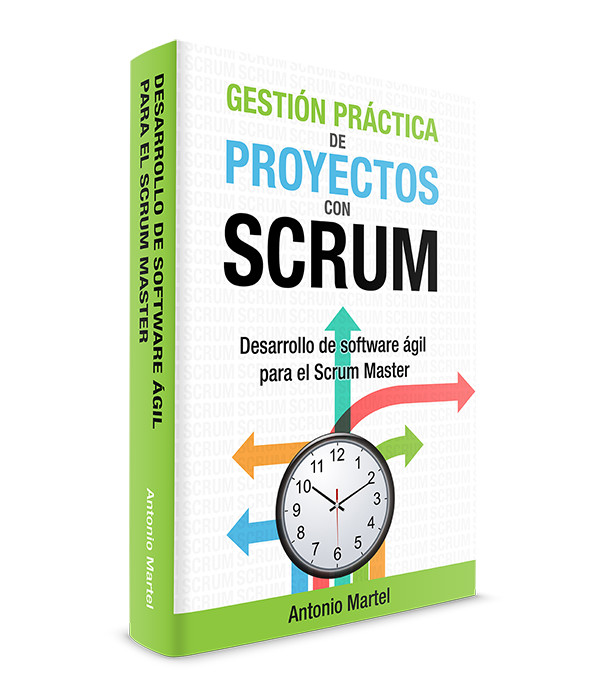
Ya a la venta la tercera edición del libro Gestión práctica de proyectos

En unas horas Amazon tendrá a la venta la tercera edición del libro Gestión Práctica de Proyectos con Scrum. Esta edición tiene aproximadamente un 25% más de contenidos sobre la gestión ágil de proyectos y experiencias reales en proyectos probablemente muy similares a los que tú te vas a enfrentar.

Si ya tienes el libro en formato Kindle y quieres recibir una actualización sólo tienes que loguearte en Amazon y desde allí pulsar en la opción ‘Gestionar mi Kindle‘ para que los nuevos contenidos se actualicen automáticamente.

Si, en cambio, quieres comprar el libro, no necesitas un lector Kindle o descargarte una aplicación. Basta un PC o portátil con Internet y desde ahí acceder a read.amazon.com. En esa página web podrás acceder a todos los ebook que hayas comprado en Amazon.

Puedes comprar el libro en Amazon.com, Amazon España y Amazon México. Esta nueva edición estará también pronto, en aproximadamente una semana, disponible en Google Play si decides comprarlo en esa tienda online desde tu móvil o tablet Android.

Publicado en Blog, Blog 1 | Etiquetado , , | Deja un comentario

Preguntas de examen PMP con QuizPM

Si estás pensando en obtener la certificación PMP de gestión de proyectos y buscas preguntas y tests para practicar o un simulador del examen en español, échale un vistazo a la nueva web QuizPM.

Ahí vas a encontrar varios modos de examen con una base de datos de más de 1.500 preguntas similares a las que encontrarás en el examen oficial:

  • Modo Personalizado, para los que están empezando a asimilar los conceptos del BOK de PMP.
  • Modo Inteligente, donde el sistema, basándose en tu historial, te propone preguntas sobre aquellas áreas de conocimiento en las que tienes peor porcentaje de aciertos.
  • Modo Examen, para los que ya se sienten preparados para el examen real y quieren hacer una simulación lo más parecida a la realidad posible: 200 preguntas a resolver en cuatro horas con 72 segundos para responder cada una.
  • Test de prueba: Un test de 50 preguntas en el que podrás probar el simulador de forma gratuita y valorar si estás preparado ya o si quieres continuar y suscribirte para hacer tests con baterías de preguntas más grandes.
Me ha sorprendido mucho la cantidad de funcionalidades y ayudas para practicar los tests que tienes. En todo momento tienes a tu izquierda el número de preguntas que ya has resuelto, el número de minutos y segundos que te quedan para acabar pero también puedes guardar el test para continuar en otro momento y, si minimizas la pantalla o pones el foco en otra ventana, QuizPM entra automáticamente en pausa para que puedas continuar más adelante sin perder tiempo para el examen.
También me ha sorprendido el agradable diseño gráfico y lo fácil e intuitivo que es de entender tu historial de aciertos o cómo grabar y recuperar el estado del último test que estabas realizando. La web tiene un diseño responsive que te permitirá hacer los tests desde tu móvil de una forma muy cómoda y clara: no hay letras pequeñas y se adapta a varios tipos de pantalla y giros con el móvil.
No sólo está en español sino que puedes ver también las preguntas en inglés para la traducción exacta de ciertos términos del BOK de PMP. Esto es importante si vas a realizar el test fuera y lo tienes que realizar en inglés pero los libros que has leído han sido siempre en español.
Les dejo con algunas imágenes de la aplicación:


Publicado en Blog, Blog 1 | Etiquetado , , | Deja un comentario

Tercera edición del libro Gestión práctica de proyectos con Scrum

En unas semanas estará disponible en Amazon, en su versión ebook, la tercera edición del libro Gestión práctica de proyectos con Scrum.

Más de 25 nuevas páginas de contenidos que incluyen más información sobre cómo hacer estimaciones ágiles, lecciones aprendidas en el trabajo diario, los principios y valores detrás del movimiento ágil o qué hacer con los requisitos que cambian durante el proyecto.

Si has comprado el libro ya, pásate de nuevo por la página de Amazon, que deberás recibir una actualización de contenidos automática cuando la tercera edición esté ya publicada. Deberás entrar con tu usuario en la página, ir a Gestionar mi Kindle, seleccionar este libro y actualizar los contenidos.

Si quieres leer el libro y no tienes un lector Kindle o no quieres descargarte la aplicación para tu PC, móvil o tablet, siempre puedes leer el libro yendo a la página read.amazon.com. Allí, con la cuenta de correo con la que compraste el libro, podrás leer cualquier ebook que hayas comprado en Amazon, aunque no tengas un lector Kindle.

Aquí tienes también los accesos al libro en los tres Amazon donde puedes comprarlo (también está disponible en Google Play)

Amazon.com
Amazon.es
Amazon.com.mx
Publicado en Blog, Blog 1 | Etiquetado , , | Deja un comentario

Demasiado pequeño para fallar

Existe un término, Kaizen, muy conocido en las empresas o la organización industrial, o mejora continua, que es cada vez más aplicado en todos los sectores de la economía pero también en la vida social o en la medicina.

Esta filosofía proviene de los cambios que Japón aplicó a los problemas de productividad y calidad que tenía su industria al final de la Segunda Guerra Mundial. Expertos como Deming (sí, el mismo de ITIL y el ciclo de Deming) acudieron a Japón a formar a cientos de profesionales e ingenieros en los sistemas de calidad y mejora.

Estados Unidos ya aplicaba estos sistemas pero Japón los evolucionó y mejoró hasta devolverlos, años más tarde, a los propios americanos como nuevas filosofías en la forma de trabajo.

El principio en el que se basa Kaizen es en el de hacer pequeñas mejoras continuas, analizar los resultados de este cambio y actuar de nuevo para introducir luego un nuevo cambio que permita mejorar, de nuevo, la productividad o la calidad de lo que estamos haciendo.

Hacer pequeños cambios y poco a poco es más efectivo que realizarlos todos a la vez de una sola tacada. Se evita así el natural miedo al cambio y la procastinación a la hora de empezar a acometerlo. Estos pequeños cambios, realizados de forma continua, terminan convirtiéndose en un hábito generando resultados permanentes.

Se trata de hacer el cambio tan fácil que sea difícil fallar en su implementación. Una vez se haya cogido el hábito de este cambio, se tratará de añadir un nuevo cambio o ampliar la meta del actual para que mejoremos de forma continua.

Es importante también aplicar los cambios de uno en uno, evitando la complejidad de saber qué aplicar y cuando. Así podremos analizar el resultado de cada una de estas mejoras. Si aplicamos varias a la vez, no sabremos cuál ha funcionado y cuál no o si el efecto de una anuló la otra.

En tu proyecto puedes decidirte a implantar de golpe todas las prácticas de Scrum, TDD, pruebas unitarias, integración continua y un largo etc. pero probablemente lo único que consigas es volver loco al equipo de trabajo. Sí, todas esas prácticas son buenas para tu proyecto pero ¿estás cumpliendo las más básicas? ¿tienes un buen control de versiones? ¿estás entregando software cada dos semanas? Es mejor empezar por las más sencillas o las que crees que traerán una mejoría mayor. Luego puedes ir añadiendo las otras.

Lejos del software, empresas como SPB, la productora de marcas como Bosque Verde, aplican Kaizen y Lean en su producción. Su director industrial afirma:

S.P.B. ha logrado mejorar un 15% su productividad sin invertir en maquinaria ni reducir plantilla. Los sistemas aplicados han permitido a la sociedad reducir entre el 15% y el 25% las diferentes partidas de gastos, mejorar en un 45% la gestión de las materias primas y reducir el periodo de producto en stock once días.

SPB tenía previsto realizar grandes inversiones y abrir nuevas fábricas en el norte de España pero las ha paralizado para centrarse en su plan de mejora de la productividad.

También en la salud o la vida personal podemos aplicar estos cambios. Si siempre hemos querido escribir un libro o un blog podemos proponernos escribir 1000 palabras al día pero lo más probable es que lo dejemos poco después. En cambio si nos proponemos escribir sólo 50 el cambio será tan fácil que nos será difícil fallar. Una vez hayamos cogido el hábito de sentarnos 15 minutos al día a escribir podemos incrementar el reto y ampliarlo poco a poco.

En cuanto a mí, también he aplicado técnicas como éstas aunque casi sin darme cuenta. Cuando publiqué mi libro apenas se vendía. Estuvo durante semanas y semanas con las cuatro tristes ventas de F&F (Family & Friends) pero no lo dejé ahí aparcado y opté por cambiarlo de categoría dentro de Amazon. Luego le cambié la portada, amplié el libro con algunos capítulos más y estuve mejorando la descripción hasta dar con la que parecía óptima.

Alguno de estos pequeños cambios hicieron que las ventas aumentaran hasta en un 50% de una semana a otra. Si lo hubiese dejado ahí, el libro nunca hubiese alcanzado posiciones relevantes en sus categorías y habría pensado que su contenido no era interesante o que no podía venderse bien sin una editorial profesional detrás.

Referencias:

Si te ha gustado este post, puedes encontrar más contenidos que expliquen Scrum de forma práctica y desde su base en mi libro en Amazon Curso práctico de Scrum: Algo más que teoría.

Libro en Amazon: Curso práctico de Scrum: Algo más que teoría
Libro en Amazon: Curso práctico de Scrum – Algo mas que teoría
Publicado en Blog, Blog 1 | Etiquetado , , | Deja un comentario

Gestión práctica de proyectos en Google Play

No sólo de Amazon viven los libros. Desde hace unos días, mi libro Gestión práctica de proyectos con Scrum está en preventa en Google Play Books. Puedes reservarlo ahora que lo recibirás la próxima semana cuando esté a la venta de forma oficial.

Google Play es el antiguo Android Market y es algo así como el iTunes de Apple. Es una tienda online en la que puedes comprar desde música, libros y películas hasta teléfonos móviles.

Google Play Books (o Libros) es también una app que viene incluida por defecto en todos los móviles y tabletas Android. Si la buscas dentro del menú aplicaciones de tu móvil la encontrarás junto a Play Store, Play Música, Play Películasm, etc. Una vez comprado el libro podrás leerlo en el móvil con esta app o desde tu propio navegador en un PC o portátil.

En el momento en el que escribo esto, si buscas la palabra Scrum en Google Play Books, el libro aparece en la tercera posición del resultado de las búsquedas (supongo que estará priorizando los resultados en español y por eso sale algo más alto) ¡A ver si se mantiene ahí!

Les dejo aquí el enlace al libro en el Google Store:

Gestión práctica de proyectos con Scrum en Google Play Books
Gestión práctica de proyectos en Google Play Books

Publicado en Blog, Blog 1 | Etiquetado , , | Deja un comentario

Gestión práctica de proyectos con Scrum de nuevo en el Top 100

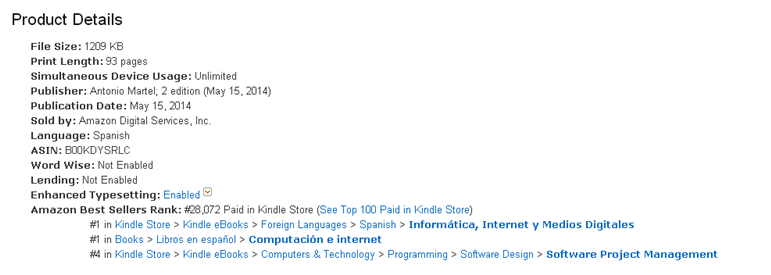
Después de la promoción de ayer de Amazon, Gestión práctica de proyectos con Scrum, está desde ayer de nuevo en la lista de libros más vendidos en Amazon España. Hoy sobre las 10:00 de la mañana llegó a alcanzar el puesto número 5 en ventas siendo número 1 en tres categorías al mismo tiempo entre los libros Kindle:

  • Internet y web entre los libros Kindle
  • Programación y desarrollo de software entre todos los libros (papel y ebooks)
  • Internet y web entre todos los libros (papel y ebooks)
En Amazon.com alcanzó también el puesto número 4 en la categoría Gestión de proyectos software (ebooks de todos los idiomas).
En el momento en que escribo esto, el libro está en el puesto número 11 de la lista de más vendidos de la Tienda Kindle de Amazon. En el 15 está El regreso del Catón de Matilde Asensi y en el 21 Palmeras en la nieve de Luz Gabás (claro que ellos estarán mañana ahí también y mi libro mucho más abajo).

Publicado en Blog, Blog 1 | Etiquetado , , | Deja un comentario

Mi libro de nuevo en la Kindle Flash

Hoy domingo estará mi libro Gestión práctica de proyectos con Scrum entre los promocionados hoy por Amazon en su selección Kindle Flash.

Junto a mi libro están también de promoción:

  • La nube en la que vivo. Calum (El libro oficial) de Calum Heaslip.
  • El secreto del alquimista de Scott Mariani.
También en Kindle Flash con otros precios promocionales podrás encontrar libros como Nunca dejes de bailar de Carmen Grau o una selección de libros de Julia Navarro como Dime quién soy o Dispara, yo ya estoy muerto.

Si aún no lo has leído, anímate a comprarlo. Con esta promoción estará durante todo el día con un descuento del 75%.

Haciendo clic en la portada tienes el enlace a la oferta de hoy en Kindle Flash de Amazon.com, Amazon.es y Amazon Méjico:

Amazon.com
Amazon.es
Amazon.com.mx
Publicado en Blog, Blog 1 | Etiquetado , , | Deja un comentario

Las cosas se hacen bien pero no demasiado bien

Esa es una frase que escuche en una ocasión a un médico cuando la enfermera le preguntaba si debía usar un tipo u otro de catéter. Lo que quería decir el médico era que no había necesidad de usar el catéter más caro, complejo o difícil de poner si con el más sencillo lográbamos lo mismo.

Es una regla útil para aplicarla en nuestros proyectos de trabajo o personales. Nos pasa cuando vamos a entregar una propuesta o un presupuesto, cuando simplemente debemos enviar un email o un informe o cuando tenemos que entregar una nueva versión de nuestro producto.

A veces lo hacemos por un perfeccionismo excesivo que nos hace pensar que nuestro producto debe tener las mejores características del mercado en todas y cada una de las funcionalidades. Cuando acabemos habremos terminado orgullosos de él pero, qué coste tiene el producto si tiene el Wifi más avanzado, el Bluetooth de mejor rendimiento y el mayor número de puertos USB ¿te lo comprarán a ese precio?

Y cuando por fin hayas decidido poner el producto en el mercado después de tantos meses de trabajo puestos en él ¿se seguirá usando el Bluetooth? ¿el número de puertos USB seguirá siendo una decisión relevante en la compra? Probablemente no.

Quizás era mejor haber planificado una fecha de lanzamiento, el próximo Black Monday por ejemplo, y calcular qué opciones nos da tiempo de construir para entonces. Seguro que en el mercado habrá productos más completos pero ¿serán tan económicos como el tuyo? ¿son tan fáciles de usar o pesan tan poco como tu producto? ¿tus competidores estarán teniendo tanto margen comercial como tendrías tú?

Cuando Google lanzó su Google Docs en la nube, los periodistas especializados fueron corriendo a preguntar a Microsoft por esta nueva amenaza a su MS Word. Google Docs era gratis y podía usarse desde cualquier ordenador sin instalación o licencia alguna. Steve Ballmer contestó de manera un tanto despectiva que Google Docs nunca a sustituir su clásica suite Office. En la nueva aplicación de Google ni siquiera era posible imprimir los documentos que escribías.

La respuesta de Google fue rápida. Al día siguiente Google Docs tenía implementado un botón Imprimir en su barra de herramientas ¿Cómo pudo haber hecho esto Google tan rápido? Sencillo, Google Docs no tiene funcionalidades complejas. Sólo hay 5 ó 6 funcionalidades en un único menú. Son justo las funcionalidades que necesitan el 90% de los documentos que escribimos.

No había mucho que desarrollar tampoco había mucho que probar. Debieron usar una librería de exportación a PDF estándar que recoge las características básicas y listo. No hay complicadas opciones de numeración, viñetas, estilos, fuentes o formatos. Sería una librería muy probada para esas pocas opciones por lo que no había mucho donde fallar.

En tu trabajo diario te puede pasar lo mismo. Puedes estar días y días buscando una diferencia de 1 céntimo entre el Debe y el Haber, pero mientras, el informe de pérdidas y ganancias está sin hacer.

Puedes hacer un versión de tu software para iPad, para tablets, para smartphones, para Chrome, Firefox Internet Explorer y Safari. Mientras tanto alguien está ganando dinero ya con su app para el iPhone pero sobre todo sabrá ya a estas alturas si merece la pena sacar una versión para Android o si estará tirando su tiempo y su dinero si lo hace.

Evita la procastinación, el miedo a fallar o a las críticas si tu producto no es el mejor de todos los que hay en el mercado o no se vende bien. Si eso pasa, bueno, por lo menos no invertiste demasiado en ello. Ve a por el siguiente o trata de mejorarlo en una siguiente versión (Kaizen lo llamaría yo). Ahora ya sabes qué es lo que no funciona y podrás probar de nuevo.

Publicado en Blog, Blog 1 | Etiquetado , , | Deja un comentario

Esfuerzo y práctica

Hace muchos años, cuando se comenzaba a conocer cosas sobre la plasticidad del cerebro humano, su capacidad para regenerarse o adaptarse y que con la práctica y la estimulación de ciertas zonas se podían mejorar sus resultados, se pidió a grandes genios de la época que, una vez fallecieran, donaran sus cerebros a la ciencia (curiosamente nadie quiso hacerlo antes).

Los científicos querían estudiar qué tenían estas personas de especiales y, una vez descubierto, su idea era que todos pudiéramos estimular y ejercitar estas zonas para convertirnos en genios de la humanidad.

Pero después de estudiar unos cuantos cerebros, no encontraron nada de especial. Ni las neuronas iban más rápido, ni tenían una cantidad especial de conexiones entre ellas, ni nada de nada. Lo único que encontraron es que tenían una zona del cerebro hiper-desarrollada, más grande de lo normal. Era una zona dedicada a la memoria y que el cerebro utiliza para recordar cosas, pero que los científicos ya habían visto desarrollada así en taxistas de Londres.

Londres es una ciudad gigantesca, con miles y miles de calles y los taxistas que llevan muchos años trabajando en ella son capaces de recordar de memoria un gran número de calles. Obviamente, los taxistas de Londres no son genios (al menos no todos ellos). Entonces ¿qué hacía tan especiales a esos premios Nobel que donaron su cerebro a la ciencia?

Fue unos años más tarde cuando surgió otra teoría que trataba de explicar este fenómeno. Era la llamada teoría de las 10.000 horas del libro Outliers. Esta teoría decía que la gente que destacaba en sus profesiones o deportes era debido a que había invertido a lo largo de su vida unas 10.000 horas en perfeccionar su técnica.

Se había visto que el primer violinista de una orquesta contaba con 10.000 horas de práctica, el segundo sólo 7.000 y así consecutivamente. Lo mismo para el cirujano principal de un hospital o el golfista que destaca ese año en el campo.

Macauley, una gran jugador de baloncesto en los años 50 que fue el primer MVP en un partido all-star, decía ‘Si no estás practicando, alguien, en algún lugar, lo está haciendo, y cuando te enfrentes a él, te va a ganar‘.

Pero (de nuevo hay un pero) esta teoría tampoco lo explica todo. Todos conocemos a balocentistas, golfistas o jugadores de fútbol que llevan más de 10.000 horas de práctica y nunca van a llegar ni a tercera regional (no quisiera vivir cerca del violinista que después de 2.000 horas de práctica aún está ensayando canciones de principiante).

Aquí es cuando llega una tercera teoría que explica que lo que tenían estas personas en sus cabezas no era más que curiosidad. Sí, simple curiosidad. Ganas de hacer, de saber, de comprender o como lo queramos llamar.

Esto es lo que hacía que esos genios que donaron sus cerebros tuviesen el suficiente entusiasmo como para dedicar 10.000, 20.000 o más horas de su tiempo a lo que les apasiona, probando cosas diferentes cuando algo no les funciona e intentando cosas nuevas que les lleve por caminos distintos.

Así que si quieres convertirte, por ejemplo, en un experto arquitecto Java, ya sabes más o menos el esfuerzo que tienes que ponerle. Por otro lado, asegúrate de que te gusta mucho a lo que te vas a dedicar. Vas a invertir ahí mucho tiempo y si no te apasiona lo que haces vas a ser difícil que llegues a un nivel avanzado. 1000 horas repitiendo lo mismo no suman más que las 50 primeras que fue lo que tardaste en aprenderlo.

Referencias:

  • Outliers, Malcom Gladwell.
  • Agile Innovation, Langdon Morris
Publicado en Blog, Blog 1 | Etiquetado , | Deja un comentario

Gestión práctica de proyectos de nuevo en la Kindle Flash de Amazon

Mi libro Gestión práctica de proyectos con Scrum ha sido seleccionado de nuevo para una promoción de Amazon: Kindle Flash

Estas promociones Kindle Flash son promociones en las que, durante 24 horas, 3 libros seleccionados por Amazon son destacados en una newsletter que Amazon envía a todos los suscritos. Desde ahí, los usuarios de Amazon pueden comprar alguno de los libros promocionados ese día con un descuento de hasta el 80%.

Puedes suscribirte a la newsletter en este enlace para Amazon.es si estás en España, o en Amazon.com para otros países. Ahí estará mi libro a menos de 1$ entre las 12:00 am hasta las 11:59 pm del 14 de febrero. Además, suscribiéndote a esa newsletter puedes descargarte un ebook gratuito.

En este otro enlace puedes ver también los libros Kindle que estarán de promoción hasta las doce de la noche de hoy en Amazon Kindle Flash.

Si quieres leer el libro y no tienes un lector Kindle o no quieres descargarte la aplicación para tu PC, móvil o tablet, siempre puedes leer el libro yendo a la página read.amazon.com. Allí, con la cuenta de correo con la que compraste el libro, podrás leer cualquier ebook que hayas comprado en Amazon, aunque no tengas un lector Kindle.

Aquí tienes también los accesos al libro en los tres Amazon donde puedes comprarlo (si no quieres esperar al descuento del 14 de febrero):

Amazon.com
Amazon.es
Amazon.com.mx
Publicado en Blog, Blog 1 | Etiquetado , , | Deja un comentario

Requisitos que pueden cambiar

Hace ya unos cuantos años, antes de aplicar por completo todo esto de agile, trabajé en el desarrollo de una aplicación web que debía gestionar las fichas de trabajo del cliente mediante una serie de pasos o wizard que guiase al usuario sobre la fase en la que estaba.

Realizamos un análisis completo, recopilamos todas las necesidades que el cliente tenía y de ahí salieron una lista de funcionalidades a implementar. Todo normal. Funcionalidades correctas y coherentes que solucionaban problemas concretos. Con el grueso documento de requisitos y su correspondiente diseño nos pusimos a implementar, una tras otra, cada una de estas funcionalidades.

En aquel momento ya intentamos ser algo ágiles (some way) e íbamos enseñando en pre-producción cada dos semanas lo que íbamos haciendo. No tenía mala pinta. Era fácil de usar e incluso nos dieron la enhorabuena por el trabajo que iban viendo. Estábamos contentos por lo que continuamos así hasta desarrollar con no poco esfuerzo hasta la última de las funcionalidades que estaban en el documento de análisis aprobado. Y subimos a producción…

En cuanto los administrativos estuvieron unos días usando la aplicación se dieron cuenta que habrían venido bien algunos cambios: incluir una tabla en cada pantalla con los documentos originales para no perderlos de vista, evitar salir a otro menú cuando se quiere crear una entidad, añadir más controles para evitar errores al finalizar una ficha, etc. La mayoría eran pequeños cambios que no llevarían más de 2 o 3 días de desarrollo pero nosotros ya habíamos acabado el presupuesto (y más).

Entre las funcionalidades que habíamos desarrollado al principio, había algunas de bastante complejidad que te permitían complicados cambios entre procesos, y que costó bastante desarrollar (y testear para tener en cuenta todos los posibles casos). Pregunté por ellas meses después pero nadie sabía de su existencia ni en qué menú estaban. Tampoco le dieron importancia. Cuando habían necesitado algo parecido cancelaron el proceso y empezaron uno nuevo.

Cuando empezamos el proyecto, ni yo, ni el cliente, ni los usuarios teníamos una idea exacta de lo que iba a funcionar bien. Simplemente no podíamos saberlo a ciencia exacta. ¿Qué podíamos haber hecho para evitar esto? Pues subir a producción en cuanto tuviésemos las funcionalidades básicas para los primeros procesos. Ahí habríamos visto con facilidad todos estos pequeños cambios que habrían hecho la aplicación más práctica y fácil de usar.

Desde entonces, en nuevos proyectos, cuando los usuarios ven la necesidad de cambios como éstos, me preguntan por la posibilidad de incluirlos. No tienen ningún problema en descartar otras funcionalidades de las que ya ni se acuerdan porqué las pusieron en los pliegos de contratación o a las que ahora no le ven tanto sentido.

La lista de funcionalidades está estimada desde el inicio en el product backlog y el cliente conoce esta estimación. Simplemente nos dice ‘Quítame la funcionalidad número 18 que llevaría 8 días de trabajo y cámbiamelas por estas dos nuevas que suman 6. Guardamos estos dos días por si solicitásemos algún cambio más‘.

Éste es otro de los principios ágiles:

Welcome changing requirements, even late in development. Agile processes harness change for the customer’s competitive advantage.

En general supone una ventaja para el cliente que obtiene un producto que le funciona y que no queda cojo hasta que se realice una nueva contratación para un mantenimiento evolutivo (a pagar con dinero extra), pero también es una ventaja para nosotros como proveedores que sumamos un proyecto que nos sirve referencia, en el que controlamos bien cada hora invertida y evitamos entregar un producto, en el que gastamos todo el presupuesto y al que le faltan cosas importantes.

Publicado en Blog, Blog 1 | Etiquetado , | Deja un comentario

Primer encuentro de autores indie de Amazon

Hace ya algunas semanas Amazon me invitó a asistir al Primer encuentro de autores independientes de Amazon en España en el Colegio Oficial de Arquitectos de Madrid. Allí nos reunimos unos 200 autores que editamos nuestra propia obra junto a profesionales del periodismo o la edición.

Como sé que algunos de los lectores de este blog tienen ya publicado o quieren publicar su libro en Amazon les dejo con algunas de las notas que me parecieron más importantes y que no siempre pueden encontrarse con facilidad en Internet:

  • Es importante la selección de las categorías en las que se encontrará tu libro. Si no alcanza buenos puestos en la categoría actual es mejor seleccionar categorías más específicas.
  • Echar un vistazo a cómo queda la descripción de tu libro en formato móvil. Cada vez más lectores acceden a Amazon desde uno de esos dispositivos y lo que allí vean les ayudará a decidir si compran tu libro o no.
  • Recomiendan poner el precio x,99 en Amazon.com y Amazon.es. Aumenta las ventas. Para Amazon Méjico x9,00 (por ejemplo 49,00 o 79,00 pesos).
  • No poner conversión automática de moneda entre los distintos mercados. El cambio de moneda cambia cada día y esto hace más difícil que tu obra sea seleccionada para una promoción de Amazon. Poner, por ejemplo, precios específicos: 2,99 para .com, 3,99 para .es y 49,00 para .com.mx.
  • Para ser seleccionado para una promoción de Amazon debes cumplir que:
    1. Hayas vendido al menos un libro diario en los últimos 30 días.
    2. El precio sea superior a 2,99 euros o 39 pesos (si no el descuento de la promoción no tendría mucho sentido).
    3. Esté a la venta al menos en los tres mercados principales de habla hispana: Amazon.com, Amazon.es y Amazon.com.mx.
    4. Tenga al menos 3 estrellas de media en las valoraciones.
  • Muchos títulos pre-aprobados para promoción pero sólo hay 200 plazas al mes.
  • Las portadas de los libros deben verse y leerse bien en blanco y negro. Muchos lectores acceden con Kindle readers que sólo muestran pantallas en B/N. Enseñaron algunos ejemplos y no había manera de distinguir letras del título o del autor sobre las imágenes del fondo.
  • Otra buena recomendación: Incluir un capítulo al final del libro para solicitar al lector que incluya una recomendación a tu libro en Amazon.
  • Trabajar con correctores y redactores para que revisen tu obra y le den un perfil más profesional a tu libro.
  • Tiempos medios que un lector de Amazon dedica a valorar tu libro por cada una de las secciones:
    • Las secciones que tú controlas:
      • 6 segundos: Valoraciones, precio, portada.
      • 4 segundos: Descripción.
    • Lasa secciones que no controlas:
      • 9 segundos: Primeros 2-3 comentarios.
      • 8 segundos: Recomendaciones/sugerencias automáticas
  • Considerar la traducción del libro. El mercado en inglés es 10 veces más grande que el hispano.
Ahora unos enlaces al evento en las noticias y fotos tomadas ese día:
Fotos:
Publicado en Blog, Blog 1 | Etiquetado , , | 2 comentarios

Principios detrás del movimiento ágil

Hace casi 15 años, en 2001, se reunieron en Utah diecisiete profesionales del software críticos con los modelos de desarrollo de software que se llevaban hasta entonces. Los consideraban demasiado pesados o rígidos. En esa reunión estaba gente como los fundadores de Scrum o Kent Beck y Martin Fowler. Habían quedado para hablar sobre nuevas técnicas y procesos para desarrollar software.

De esa reunión salieron una serie de principios que debían cumplir los nuevos métodos alternativos (y ágiles) que estaban proponiendo: Principios detrás del manifiesto ágil.

Uno de estos principios es:

Our highest priority is to satisfy the customer
through early and continuous delivery
of valuable software.

Parece obvio que esto es lo que debe hacerse en cualquier desarrollo y con ese ánimo comenzamos cada nuevo proyecto pero pronto comienzan las prisas. Nuestro director nos pregunta cuántas horas llevamos empleadas (y llevamos ya muchas), nuestro cliente nos pregunta cuándo va a tener listas todas las funcionalidades y nuestros compañeros de trabajo nos preguntan si ya pueden cogerse las dos semanas de vacaciones que les debemos.

Empieza a pintar feo. Ya nos hemos vuelto a meter en un jaleo. Tenemos que volver a rehacer el diagrama de Gantt con las nuevas fechas de entrega programadas, tenemos que buscar otras fechas para las vacaciones (incluso las nuestras) y tenemos que dar un montón de explicaciones al director: ‘Es que nos han pedido cambios, es que las tecnologías eran nuevas, es que estimamos mal’.

A partir de aquí es cuando tendemos a ponernos firmes, a exigir un esfuerzo adicional al equipo de trabajo y a negar cualquier pequeño cambio al cliente. Si no está exactamente escrito así en el contrato que firmamos o en el acta de una reunión que tuvo lugar hace seis meses, lo siento, pero no lo haremos.

El caso es que el cliente también hizo esto. Redactó un contrato muy claro en el que te dijo cada una de las funciones que quería (o las que quería en el momento de redactarlo). Quizás ya no las necesite o se haya dado cuenta de que hay otras más importantes pero están en el contrato y hay que hacerlas. El proyecto no puede acabar y dejar un 30% de funcionalidades por hacer.

En este momento ya hemos perdido de vista la que debe ser la máxima prioridad en nuestro trabajo. Entregar de forma continua software que funcione y que aporte valor. A partir de aquí ya no quedan sino duras negociaciones y un contrato que trataremos de cerrar cuanto antes con el menor daño posible.

El contrato podrá tener muchos artículos y estipulaciones pero, ponga lo que ponga, cuando el cliente lo redactó lo que quería era una solución a su problema, no una discusión sobre si se debe o no implementar esa función o la otra.

Pero, si vamos entregando cada poco tiempo el software que vamos haciendo, lo dejamos para que lo pruebe y lo use, que nos diga su opinión. Dejemos que encuentre lo que echa en falta o lo que podría mejorar. Va a querer que le implementemos esto que ahora ha visto que necesita y estará encantado de quitar a cambio esa funcionalidad para exportar a ficheros .rpt que ya ni se acuerda de quién se lo pidió ni por qué.

Al finalizar el proyecto el cliente tendrá un producto que de verdad resuelve sus problemas, que ha ido evolucionando a medida que él mismo aprendía y que ha podido usar y probar desde las primeras semanas del proyecto. Suena mejor para cliente y proveedor ¿no?

Publicado en Blog, Blog 1 | Etiquetado , , | Deja un comentario