New book, new prezi. I have prepared for you a presentation of the upcoming book Agile 101. There you can find a short description of the chapters you can find inside.
Check it out on Prezi site or directly here:

New book, new prezi. I have prepared for you a presentation of the upcoming book Agile 101. There you can find a short description of the chapters you can find inside.
Check it out on Prezi site or directly here:

In the late 1960s, a university professor carried out a psychological experiment. He left two identical cars in two different neighbourhoods. One in a poor, high-crime neighbourhood in the Bronx, New York. The other one in a rich, quiet area of Palo Alto, California. Shortly after it was abandoned, the car in the Bronx started to have all its parts stolen. First the radio, then the tires, the mirrors, and anything of value. Yet the car abandoned in California remained undamaged. The study did not end there. When the car in the rich neighbourhood had been intact for a week, the researchers broke one of its windows. This escalated quickly, and soon afterwards the effect was the same as it had been in the Bronx. Theft and vandalism swiftly reduced the car to its bare bones in both neighbourhoods. A car with broken windows sends out a message of disrepair and negligence. It spreads the notion that anything goes. Every new act of vandalism reinforced and broadcast the idea that nobody was taking care of that car. That nobody cared.
A similar idea can be seen in the training of health professionals. If a patient or an elderly person has a stain, or gets dirty somehow, that person should be cleaned. Even if it’s only a little spot. If patients stay in that state, they will be less careful themselves in keeping clean. They will tend to feel that it doesn’t matter anymore, it’s already dirty. So their general state of hygiene, self-esteem, and thus health level will start to decline.
The results of this psychological study are applicable in many situations of our daily lives: from the care of our home to the maintenance of our car. But they’re also applicable to our jobs. For example, if you’re a programmer or a project manager, and you allow for a new version to be deployed. But you haven’t had it sufficiently tested. Or if you leave that technical “debt” unpaid in the code now —because “we’re in a hurry.” You’d be broadcasting to the whole team the feeling that anything goes. That “it’s enough as it is” and that one can leave quality aside. Sooner or later the phone will ring with complaints from users. Soon we will see a lengthy queue of reported bugs in our queue.
When we apply this theory to software, it’s helpful to explain the term entropy. In physics, entropy is the level of disorder or randomness in a system. Say you see badly indented or commented code. Or a bad choice when naming a variable or some bad design. Fix it as soon as possible or schedule its correction for the near future. Take some sort of action to limit disorder or it will expand. It will create the feeling that any patch or quick fix is valid.
If some code (or thrown-together code) will make your system deteriorate quickly, impeccably written and designed software will have the opposite effect. It will make new programmers avoid breaking something so beautifully built. They will make an effort to put in place the best code they can write. Now you know: make your life and your project easier by fixing broken windows as soon as they appear.
You can find texts like this and many other about how to manage agile projects in my book Agile 101: Practical Project Management (available on Amazon).
 |
| Agile 101 – Practical Project Management |
Translation by Begoña Martínez. You can also find her on her LinkedIn profile. Proofreading by David Nesbitt.

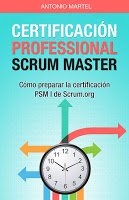
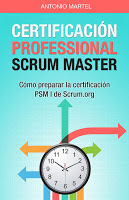
Amazon quiere celebrar durante todo el mes de octubre el fenómeno de la autopublicación con una promoción especial en una selección de libros entre los que estará mi libro Certificación Professional Scrum Master.
Durante esta promoción, llamada #PublicaConKindle, el libro estará a la venta por sólo 0.99€ en lugar de los 2.99€ habituales. Amazon publicará pronto una página especial dedicada a este evento para promocionar la publicación independiente. Pondré el enlace por aquí cuando esté listo.
Habrán muchos otros libros en promoción durante todo octubre con esta promoción así que aprovechen ese mes para ver si está en oferta alguno de los libros que les gustaría comprar.
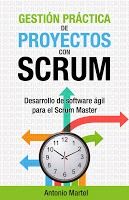
Mi primer libro, Gestión práctica de proyectos con Scrum, fue seleccionado de nuevo hace unos días para una promoción Kindle Flash. El 5 de noviembre este libro estará durante todo el día a tan sólo 1.49€. Avisaré también en este blog unos días antes por si te interesa comprar el libro en ese momento.
Aquí tienes los enlaces a mis dos libros en Amazon:
 |
| Amazon.com |
|
| Amazon.es |
|
| Amazon.com.mx |
 |
| Amazon.com |
|
| Amazon.es |
|
| Amazon.com.mx |

Un lector de este blog me preguntaba hace ya algún tiempo algunas dudas que le surgían en el uso de Scrum en sus proyectos. Algunas de ellas pueden ser bastante comunes a otros equipos de Scrum o que yo mismo he tenido cuando intentaba aplicar Scrum. Aquí les pongo algunas de estas respuestas (sería la solución que yo aplicaría en los tipos de aplicaciones que conozco pero puede que no sea el mismo tipo de proyecto/equipo/producto/etc.).
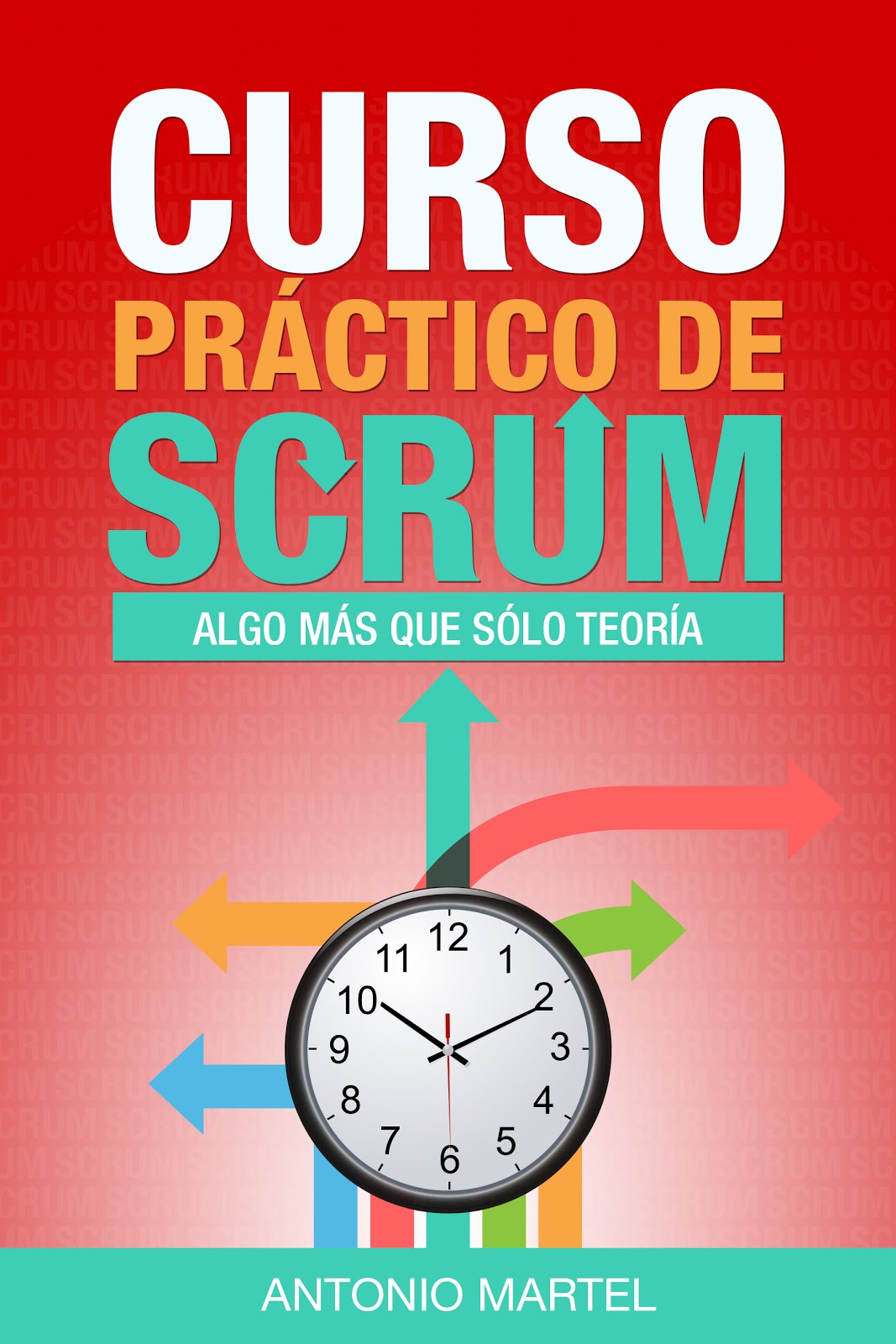
Cuidado si la opción por la que se apuesta es siempre la de ‘hay que hacerlo así ahora porque no tenemos tiempo‘. Es verdad que a veces es la solución que se debe tomar ante una urgencia. Explícale bien al equipo de trabajo el por qué de esta decisión en estos momentos pero explícale también al Cliente que ahí ha quedado un asunto por resolver que deberá ser programado para un próximo sprint si no queremos que esa deuda técnica nos acumule más errores pronto. Si no hacemos esto, con los años, el proyecto se nos puede convertir en uno de esos proyectos en los que todo el equipo de trabajo está resolviendo bugs y no nos queda tiempo para desarrollar nuevas funcionalidades.Si te ha gustado este post, puedes encontrar más contenidos que expliquen Scrum de forma práctica y desde su base en mi libro en Amazon Curso práctico de Scrum: Algo más que teoría.
 |
| Libro en Amazon: Curso práctico de Scrum – Algo mas que teoría |

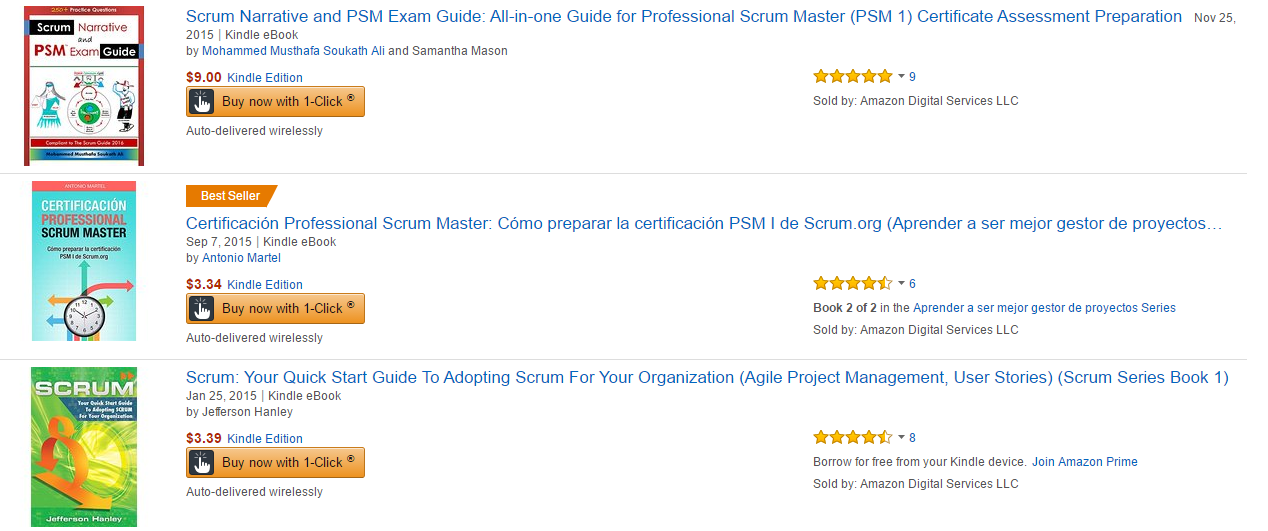
Hoy ha sido mi libro Certificación Professional Scrum Master el que ha llegado a la categoría de best seller en la categoría de Informática e Internet para los libros Kindle en español de Amazon internacional.
También ha llegado al número 6 en ventas para todos los libros (Kindle y en papel) en español para la categoría de Computación e Internet. Estas son unas imágenes de esas posiciones:
 |
| Libro preparación PSM I best seller en Amazon.com |
 |
| ebook Certificación Professional Scrum Master número 1 en Informática e Internet en Amazon.com |
Si quieres saber cómo puedes preparar la certificación Professional Scrum Master I de Scrum.org, saber que tipo de preguntas puedes encontrar ahí y prepararte con algunos pequeños tests de práctica, puedes encontrar el libro en Amazon.com, Amazon.es o Amazon.com.mx.
También puedes encontrar más información sobre esta guía de preparación para la certificación PSM I en ese enlace a esta misma web.
Aquí están los enlaces a cada una de las tiendas Amazon donde se puede comprar el libro:
 |
| Amazon.com |
|
| Amazon.es |
|
| Amazon.com.mx |